
Some materials never lose their relevance. Tibetan paper is one of them. It has carried prayers, royal edicts, medical texts and legal records across the Himalayas for centuries. Today it is also chosen by calligraphers, publishers, stationery brands and gift makers on several continents.
You may know it by another name. Tibetan paper is commonly called Lokta paper, and it is made by hand in Nepal. Tibetan Handicraft & Paper Pvt. Ltd. (THP Nepal) has spent more than three decades helping this paper reach buyers around the world.
This guide explains what Tibetan paper is, why it is valued globally, how THP Nepal became a trusted name in it, and the story of the world’s longest calligraphy scroll, written on Tibetan Lokta paper. It also covers how businesses and individuals can buy it.
What Is Tibetan Paper?
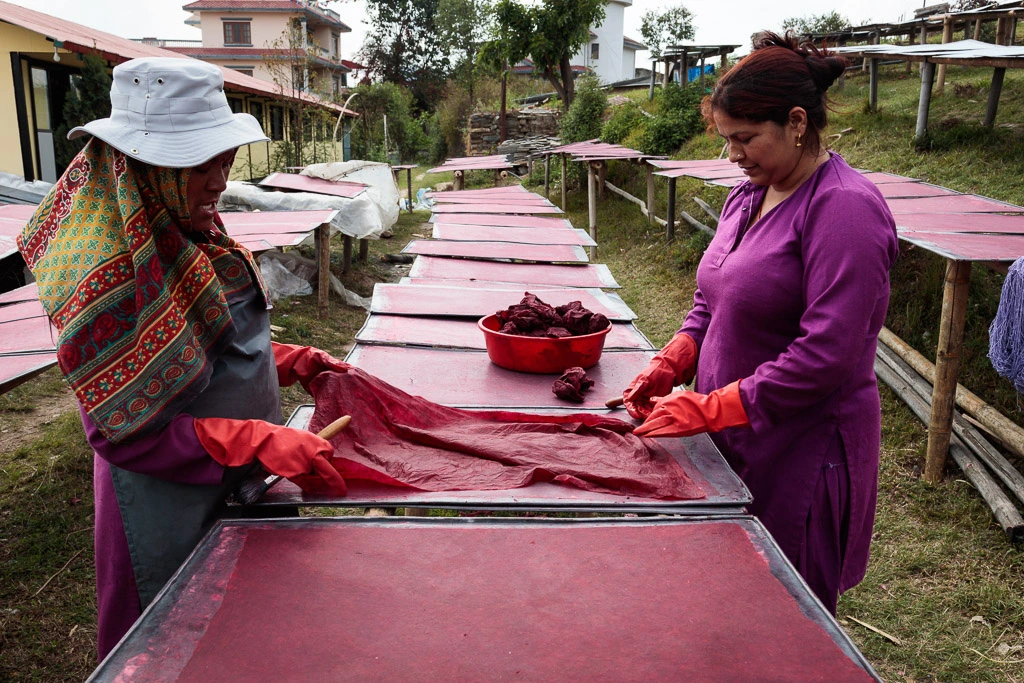
Tibetan paper is a handmade paper made from the inner bark fibre of the Lokta shrub. It is sometimes called Nepali paper, Himalayan paper or Lokta paper, and all of these names point to the same tradition.
The name “Tibetan” reflects the paper’s cultural roots. For generations, Buddhist monasteries across the Tibetan plateau and the Himalayan belt relied on this durable paper to copy scriptures and record sacred texts. Much of it came from the forested hills of Nepal and travelled along old trade routes to monasteries, courts and markets.
A single sheet of Tibetan paper has these qualities:
- A soft, slightly fibrous surface with a natural, organic character
- Strength that lets it hold ink, pigment and gold without tearing easily
- A long lifespan that suits books, documents and artwork meant to be kept
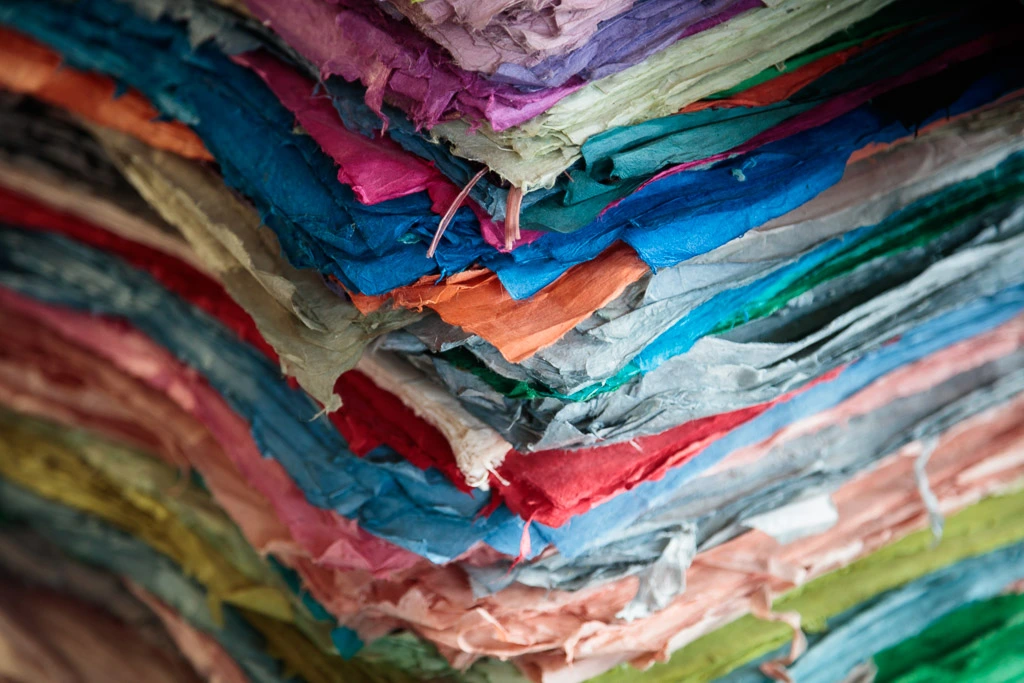
- A warm, earthy look that machine-made paper cannot copy
These qualities explain why the paper has lasted through centuries of change.
Tibetan Paper vs. Lokta Paper: Are They the Same?
Yes. The two names refer to the same family of handmade paper, and the difference is mostly about context.
“Tibetan paper” is the older, culture-led term. It points to the paper’s role in Tibetan Buddhist heritage and its use in prayer books, scrolls and calligraphy.
“Lokta paper” is the material-led term. Lokta is the shrub the fibre comes from, and the word is more common in craft, trade and export circles.
For buyers searching online, both terms are useful. THP Nepal uses both because customers find the paper through either one.
Why the World Values Tibetan Paper
Interest in Tibetan paper has grown steadily outside the Himalayas, and several trends explain it.
A move away from mass-produced materials. Designers, brands and consumers increasingly want products with a story, a maker and a place of origin. Handmade Himalayan paper has all three.
Sustainability expectations. Buyers in Europe, North America, Australia and Japan ask more questions about what their products are made from and who made them. A natural-fibre paper made by rural artisans fits those expectations well.
Creative versatility. The same paper works for journals, greeting cards, wrapping, boxes, book covers, lampshades, packaging and fine art. One material can serve many product lines.
Cultural authenticity. For artists and spiritual practitioners, the paper’s connection to Tibetan and Himalayan tradition adds meaning that a generic sheet cannot.
Together, these reasons have built steady demand in markets far from where the paper is made.
“This entire process from Himalayan forest to finished sheet honors traditions passed down through generations while meeting the precise specifications demanded by international designers, publishers, and institutions.”
How Tibetan Paper Became a Global Craft Material
For much of its history, Tibetan paper stayed regional. It moved between villages, monasteries and trading towns, and its reach followed the caravan routes.
The shift to a global material came when Nepali handmade paper entered international craft and export markets. Travellers, collectors, stationers and importers discovered the paper and began ordering it in quantity. As orders grew, buyers needed more than a beautiful sheet. They needed consistent quality, reliable quantities, proper packaging, clear communication and dependable shipping.
That is where an organised producer and exporter makes the difference, and it is the gap THP Nepal set out to fill.
THP Nepal: The Name Behind the Paper
Tibetan Handicraft & Paper Pvt. Ltd., known as THP Nepal, is a family-founded Nepali enterprise that specialises in handmade Lokta paper and paper products. It was established in 1995 in Dolakha, Nepal, as Tibetan Handicraft Industry (THI) and was later renamed Tibetan Handicraft & Paper Pvt. Ltd.
Today THP is headquartered in Budhanilkantha, Kathmandu, and its numbers show its reach:
Milestone |
Lokta Paper (THP)
Years of heritage |
30+
Artisan partners |
100+
Countries served |
20+
Core export markets |
North America, Europe, Australia, Japan
THP works on two priorities at once. The first is preserving traditional craftsmanship. The second is improving efficiency, management and sustainability so that international buyers get a reliable supply. Many heritage crafts struggle to balance these two, and THP’s longevity suggests it has managed to.
THP is also connected to the wider handicraft community through partners and associations, which adds to its credibility with international buyers.
From Dolakha to Your Doorstep: How THP Supplies the World
Making good paper is one task. Delivering it across oceans is another. THP’s global supply model rests on four things.
1. A Network of Artisan Partners
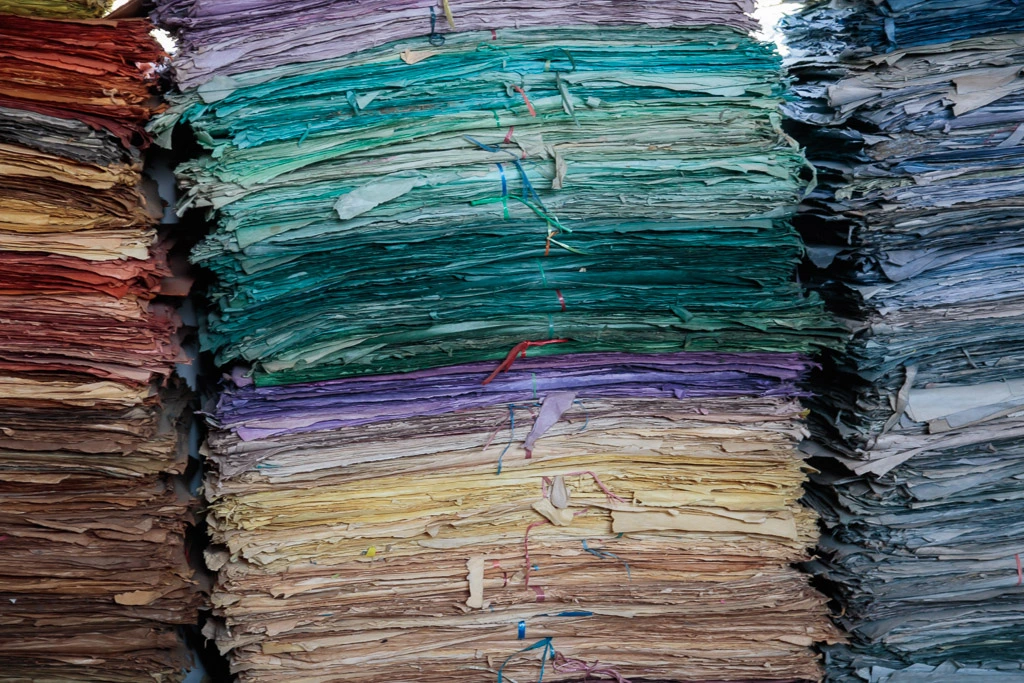
More than 100 artisan partners are part of THP’s supply base. A larger network means THP can take on bigger orders and plan production around deadlines while keeping quality consistent from batch to batch.
2. A Wide Product Range, Not Just Plain Sheets
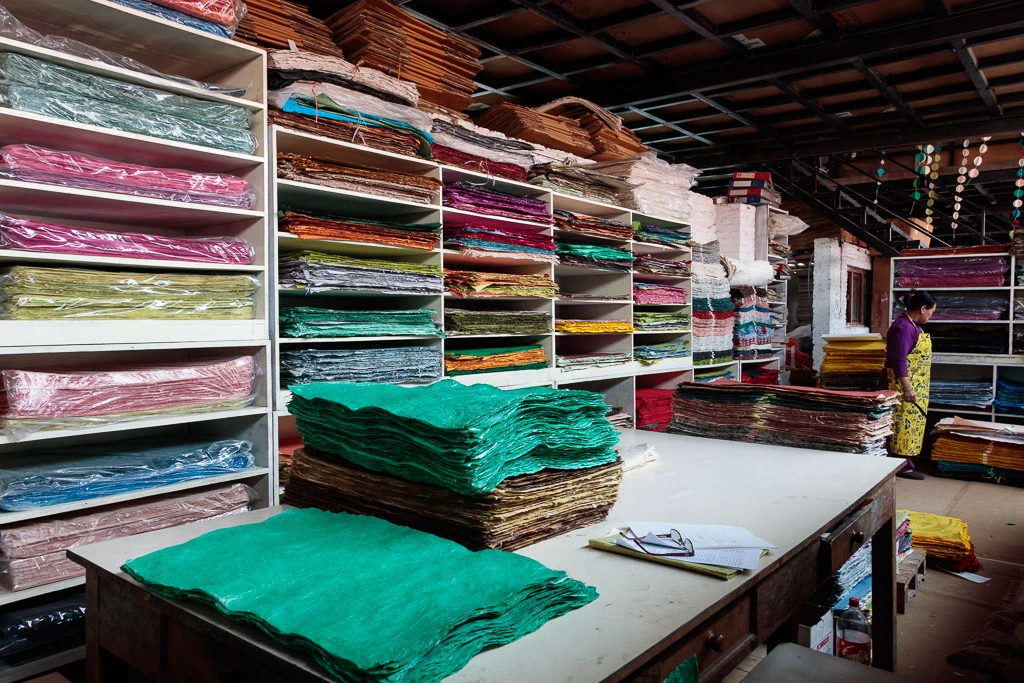
International buyers want more than raw paper. THP offers finished and semi-finished products that are ready for retail or creative use:
- Screen-printed sheet papers, including patterns such as Wave, Crystal, Flower and Tiger prints
- Lidded and hinged boxes for gifting and packaging
- Hard-cover journals for stationery and gift retailers
- Photo albums for lifestyle and home-décor markets
- Custom and private-label items for brands with their own designs and specifications
This range lets a buyer start with sheets and later expand into boxes, journals or albums from the same trusted supplier.
3. Export-Ready Service for B2B Buyers
THP works with importers, retailers, publishers and brands. Buyers can download the product catalogue, browse by category, list the items and quantities they need, and request a quote. Custom orders go through a contact form so that sizes, colours, prints and packaging can be discussed upfront.
4. Global Shipping Experience
THP exports to North America, Europe, Australia and Asia. Over three decades it has built experience with documentation, packaging and logistics, which is what separates a one-time seller from a long-term supplier.
Why Tibetan Paper Is Popular Across Different Countries
Different markets value Tibetan paper for different reasons.
Japan has its own long tradition of washi, so buyers there already appreciate fine fibre, texture and craftsmanship. Himalayan paper stands out as a distinct, respected alternative, and Japan is one of THP’s core markets.
Europe values provenance and ethical sourcing. Boutique stationers, bookbinders, packaging designers and gift brands use Tibetan paper to add a story to their products.
North America has a strong market for artisan goods, journaling, scrapbooking, card-making and spiritual or wellness products. Tibetan paper suits all of these.
Australia shows similar interest in handmade, natural and ethically made products, particularly in the craft and gift sectors.
The Tibetan and Buddhist diaspora worldwide values the paper for religious texts, calligraphy and cultural projects, which keeps alive the paper’s original purpose.
This spread across very different cultures shows that Tibetan paper appeals to more than one niche.
“Our top export destinations include The USA, China, UK, Canada and Japan, with regular shipments to more than 10+ countries.”
A World Record Written on Tibetan Paper
The strongest proof of what Tibetan paper can do is a record-setting work of art.
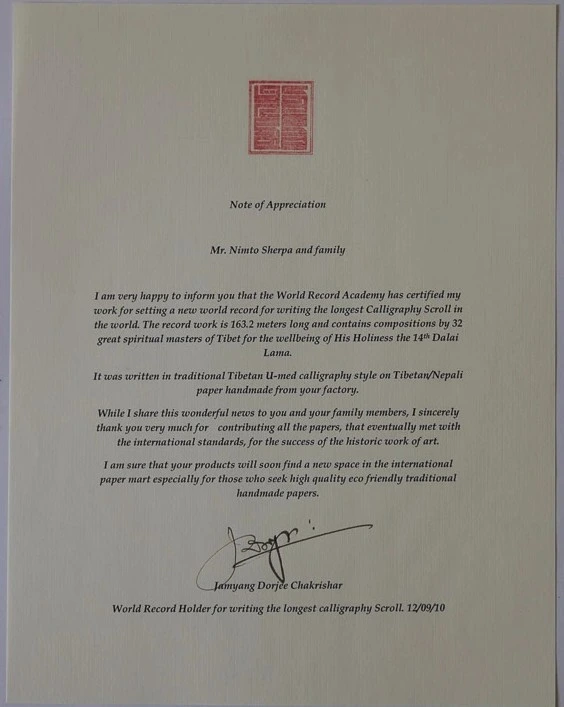
According to Tibet House US in New York, the longest calligraphy scroll in the world measures 163.2 metres. It was created in 2010 by the Tibetan master calligrapher Jamyang Dorjee Chakrishar, who spent about six months writing roughly 65,000 Tibetan characters on handmade Tibetan Lokta paper in Japanese sumi ink. The scroll carries prayers for the long life of His Holiness the 14th Dalai Lama, composed by thirty-two spiritual masters of Tibet, and it is written in several calligraphic styles, including Tsugring, Tsugthung, Tsugma Kyug and Kyug forms of Umed.
A Friendship That Made History
For THP Nepal, this record is also a personal story. Jamyang Dorjee Chakrishar is a close and valued friend of THP. According to the company’s owner, he has visited THP in Nepal, and the two share a warm, long-standing relationship built on mutual respect for the craft.
It was with Lokta paper from THP that he created his world-record scroll. The paper came from a Nepali workshop whose people he knew and trusted, and a master calligrapher turned it into the longest calligraphy scroll ever recorded.
Why This Matters for Buyers
A scroll of this length asks a great deal of its paper. Every sheet has to be consistent with the next. The paper must take sumi ink cleanly without bleeding, and it must survive months of writing, rolling and unrolling. The finished work has to look uniform across more than 160 metres and last for generations.
That a master calligrapher chose THP’s Lokta paper for such a project says more than any product description can. If it can carry a record-breaking work of devotion, it can carry your journal, your artwork, your packaging or your next product line.
Ready to Order? Contact our B2B team at [email protected] or call +977 014820727 to discuss your specific requirements, receive samples, and get competitive quotes for your project.
THP’s Part in the Story
THP Nepal’s account is that the paper for this scroll came from THP. The calligrapher then turned it into a historic work of art. This is a point of pride for the company, and it speaks to the paper itself.
Think about what such a project demands. A scroll of this length must be made from paper that is consistent from sheet to sheet. It has to take sumi ink without bleeding, and it has to withstand months of handling, rolling and unrolling. It has to look uniform across more than 160 metres, and it has to last. Few materials could meet those requirements, and Tibetan Lokta paper did.
For anyone choosing paper for a book, certificate, artwork or product line, the lesson is simple. If a paper can carry a record-breaking work of devotion, it can carry your project.
What exactly is lokta paper?
Lokta paper is handmade from the inner bark fibers of the Lokta shrub (Daphne cannabina), which grows in the Himalayan mountains of Nepal and Tibet. Unlike industrial paper made from wood pulp with harsh chemicals, lokta paper uses traditional methods and renewable materials, resulting in a stronger, longer-lasting, and completely eco-friendly product.
How long does lokta paper really last?
Properly stored lokta paper remains in excellent condition for over 100 years without yellowing, brittleness, or degradation. This makes it perfect for documents, artwork, and materials intended for long-term preservation. Some lokta papers created centuries ago are still beautifully intact today.
Why is lokta paper more expensive than regular paper?
The premium price reflects several factors: completely handmade production using labor-intensive traditional methods, renewable sourcing that requires sustainable management, lack of chemical processing that reduces production speed, and superior longevity that provides exceptional long-term value. Additionally, your purchase directly supports 100+ artisans and protects Himalayan forests.
Can lokta paper be printed on with modern equipment?
Yes, absolutely. Our lokta papers work well with offset printing, digital printing, letterpress, screen printing, and most other modern printing techniques. We recommend consulting with our technical team about your specific printing method to ensure optimal results and recommend appropriate paper weight and sizing options.
What sizes and customization options are available?
We offer standard sizes (A4, A3, letter, tabloid) and can produce virtually any custom size or thickness. For bulk orders, we develop custom solutions including special colors using eco-friendly dyes, custom finishes, specialty inclusions (like embedded botanicals), and private-label packaging.
How is lokta paper actually made?
The process begins with harvesting the inner bark of lokta plants sustainably. The bark is dried and processed into pulp, mixed with pure water to create a fiber suspension, formed into sheets using wooden frames and screens, pressed to remove excess water, and dried naturally in the sun. This chemical-free, entirely handmade process is unchanged from methods used for centuries.
Is lokta paper certified as sustainable and ethical?
Our sustainability and ethical practices are verified through partnerships with organizations including fair-trade initiatives and artisan support networks. While formal certifications vary by specific product line, all our lokta paper meets or exceeds environmental and ethical standards, with production that supports forest regeneration and fair compensation for artisans.
What are typical lead times for orders?
Standard orders typically ship within 2-3 weeks of order placement. Custom orders may require 4-8 weeks depending on complexity and specifications. We can accommodate urgent requests—contact our team to discuss specific timeline needs for your project.
Do you offer wholesale pricing for bulk orders?
Yes. We offer competitive wholesale pricing for bulk orders and can discuss long-term supply agreements. Pricing varies based on order quantity, customization requirements, and delivery timeline. Contact our B2B team at [email protected] for a detailed quote.
How can I order or request samples?
You can browse and order products through our website at tibetanhandicraftpaper.com/products. To request samples before placing a larger order, contact us via our contact form, email ([email protected]), phone (+977 014820727), or WhatsApp (+977 9767221657).
What Can You Make With Tibetan Paper?
The scroll shows the paper at its most ambitious. In everyday use, Tibetan paper suits a wide range of work.
For artists and calligraphers: Calligraphy, ink painting, printmaking, collage, mixed media and sacred texts.
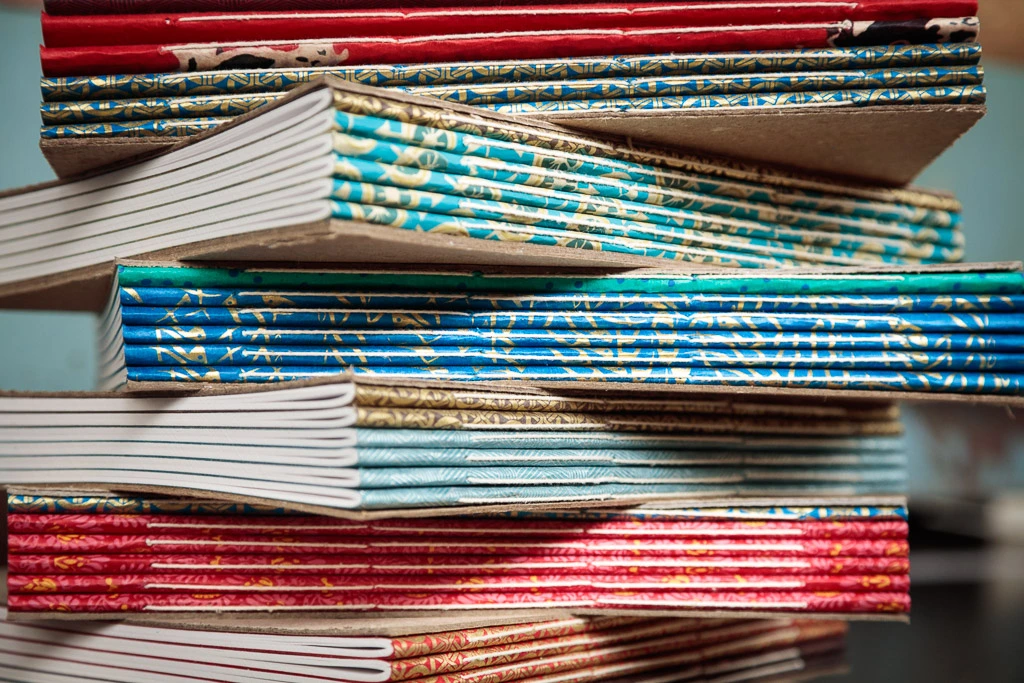
For stationery and publishing: Journals, notebooks, book covers, endpapers, diaries, greeting cards, invitations and bookmarks.
For packaging and gifting: Gift wrap, boxes, bags, labels, hang tags and luxury packaging inserts.
For home and lifestyle products: Lampshades, photo albums, wall art, framed prints and decorative panels.
For brands and businesses: Private-label stationery, corporate gifts, branded packaging and limited-edition collections with a handmade story.
Thank you for considering Tibetan Handicraft & Paper for your paper needs. We look forward to partnering with you on your next project.
How to Choose the Right Tibetan Paper Supplier
Not every supplier offers the same reliability. Before you order, consider the following.
Check for real, documented experience. A supplier with decades of operation and a stable artisan base is less likely to fail on quality or deadlines.
Look at the product range. A supplier that offers sheets, boxes, journals and custom work lets you grow without changing sources.
Ask about customisation. If you need specific sizes, prints, colours or packaging, confirm that the supplier handles custom and private-label orders.
Confirm export capability. Ask about shipping destinations, packaging standards and typical lead times for your country.
Review sustainability and ethics. Ask how the supplier treats artisans and the environment. THP states that its production is sustainable and fair, and it publishes a dedicated sustainability page.
Request a catalogue and samples. Handle the paper before committing to a large order. Touch, weight and texture tell you things photographs cannot.
How to Order Tibetan Paper From THP Nepal
Ordering from THP is straightforward.
- Browse the catalogue. Explore the product pages or download the PDF catalogue from the THP website.
- List your requirements. Note the products, quantities, sizes and any custom needs.
- Send an enquiry. Use the contact form, call, email or message THP on WhatsApp.
- Receive a quote. THP responds with pricing and details based on your requirements.
- Confirm and ship. After confirmation, your order is prepared and shipped to your country.
Experience the Difference Handmade Quality Makes
Get in Touch
📧 Email: [email protected]
📞 Phone: +977 014820727 / +977 014820728
💬 WhatsApp: +977 9767221657
📍 Location: Budhanilkantha – 11, Kathmandu, Nepal
The Future of Tibetan Paper
As buyers look for authentic, lasting and responsibly made materials, interest in Tibetan paper is likely to keep growing. Digital life has also created a counter-movement toward touch, texture and handmade objects. A notebook, a printed invitation or a wrapped gift made from Lokta paper feels different, and that difference is what people are paying for.
For THP Nepal, the aim is to keep this tradition alive for the artisans who make the paper and the communities that depend on it, while serving buyers around the world.
Tibetan Paper Is Heritage You Can Hold
Tibetan paper began as a practical material for monasteries and mountain communities. It is now a recognised craft product with a presence in studios, stationers and gift shops on several continents, and it has carried one of the most remarkable calligraphy works of our time.
THP Nepal has helped bring that story to a wider world, offering handmade Lokta paper, finished products and custom solutions with more than 30 years of experience behind them.
Ready to explore Tibetan paper for your business or project? Download the THP catalogue or contact the team to request a quote.
Frequently Asked Questions About Tibetan Paper
What is Tibetan paper?
Tibetan paper is a handmade paper made from Lokta shrub fibre. It is also called Lokta paper and has long been used for scriptures, documents and art across the Himalayas.
Is Tibetan paper the same as Lokta paper?
Yes. “Tibetan paper” highlights the cultural heritage, while “Lokta paper” names the plant it is made from.
Where is Tibetan Lokta paper made?
It is made by hand in Nepal’s Himalayan region. THP Nepal was established in Dolakha and is now based in Kathmandu.
Is Tibetan paper good for calligraphy?
Yes. The world’s longest calligraphy scroll, at 163.2 metres, was written on handmade Tibetan Lokta paper in sumi ink. This paper was from THP Nepal.
Who holds the record for the longest calligraphy scroll?
Jamyang Dorjee Chakrishar with the world record for the longest calligraphy scroll, created in 2010.
Does THP Nepal ship internationally?
Yes. THP exports to North America, Europe, Australia and Asia and serves more than 20 countries.
Can I place a custom or bulk order?
Yes. Custom orders are handled through the contact form, and bulk buyers can choose products from the catalogue and request a quote.
Is Tibetan paper eco-friendly?
It is made from natural plant fibre and produced by artisans using traditional methods. THP states a focus on ethical production, responsible sourcing and long-term environmental care.
Where didi the longest calligraphy scroll Paper came from?
The longest calligraphy scroll Paper came from Tibetan Handicrafts and paper (THP Nepal), was made as demand of Jamyang Dorjee Chakrishar. He’s friend of THP and close to the owners of thp.
How can I order or request samples?
You can browse and order products through our website at tibetanhandicraftpaper.com/products. To request samples before placing a larger order, contact us via our contact form, email ([email protected]), phone (+977 014820727), or WhatsApp (+977 9767221657).


